
Most Teams Don’t Fail at Extraction Quality
They fail at reliability.
When document initiatives stall, it’s rarely because the parser can’t extract text. Modern parsing engines are good. Very good.
Where teams struggle is everything around the parser:
- Multi-tenant isolation
- Worker reliability
- Failure recovery
- Observability
- Administrative control
- Time-to-value for downstream teams
A parser-only solution works in a demo.
A production document parsing pipeline works under load, across tenants, with operational safeguards.
This is the difference between a feature and a platform.
Why Parser-Only Solutions Break in Production
Most document parsing efforts begin with a single API:
- Upload document
- Parse synchronously
- Return extracted text
This works — until it doesn’t.
In production environments, you quickly encounter:
- Large PDFs that exceed request timeouts
- Worker crashes mid-parse
- Tenants uploading simultaneously
- Partial failures without retry logic
- No visibility into processing state
- No way for admins to intervene
The parser isn’t the problem.
The absence of lifecycle management is.
A production document parsing pipeline must handle asynchronous execution, enforce isolation, expose state transitions, and recover safely from failure. That requires architecture beyond a single endpoint.
The System Architecture: Designed for Operability
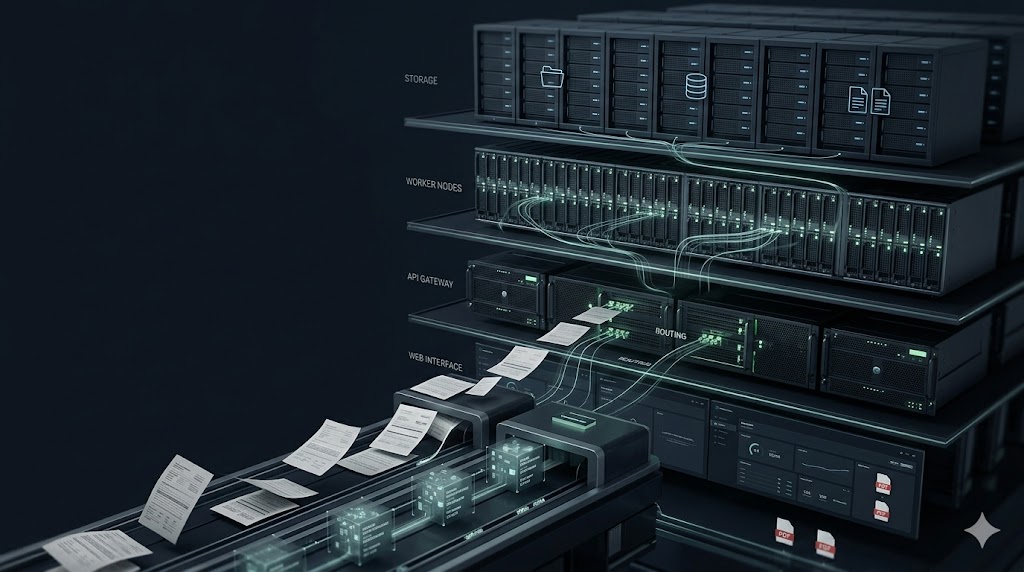
To move from parser to platform, responsibilities must be separated cleanly:
Web Console (Frontend)
Operational visibility and trust layer. Document status, chunk inspection, and structured output validation.
Backend-for-Frontend (BFF)
Security boundary and request shaping between UI and core API.
Core API
Handles intake, lifecycle state, and tenancy enforcement.
Worker Service
Isolated async processing engine. Executes parsing, chunking, and enrichment.
Admin API Surface
Retry, requeue, inspect, and override actions.
Storage Layer
Raw files, structured chunks, metadata, and audit trails stored independently.
This separation ensures:
- Horizontal scaling of workers
- Clear tenant boundaries
- Deterministic state transitions
- Operational intervention when needed
Reliability is designed in — not patched on.
The Asynchronous Lifecycle: Upload to Structured Chunks
A production-grade document parsing pipeline follows a controlled lifecycle:
1. Intake
- File uploaded
- Metadata registered
- Document status set to
pending
2. Queue & Dispatch
- Job enqueued
- Worker assigned
- Status transitions to
processing
3. Worker Execution
- Parsing engine runs
- Chunk boundaries created
- Structured outputs generated
- Intermediate failures handled safely
4. Persistence & Indexing
- Chunks stored
- Metadata persisted
- Audit trail updated
5. Completion
- Status updated to
completed(orfailed) - UI reflects final state
- Admin actions unlocked if required
This controlled lifecycle prevents:
- Lost documents
- Silent failures
- Double processing
- Cross-tenant leakage
It also creates a foundation for future enhancements: classification, enrichment, vector indexing, and policy enforcement.
Operational Controls: The Missing Layer in Most Pipelines
In production systems, failure is not an edge case. It’s an inevitability.
The difference between fragile and resilient systems is control.
A mature pipeline includes:
- Explicit document status tracking
- Retry mechanisms
- Admin-triggered reprocessing
- Worker failure isolation
- Structured logging
- Console-based inspection
Operators need levers.
Without operational controls, engineering teams become human cron jobs — manually intervening via database updates or redeploys.
With controls, reliability becomes routine.
What This Means for Time-to-Value
When reliability is engineered upfront:
- Teams integrate faster
- Downstream systems trust outputs
- Debug cycles shrink
- Production incidents decrease
- Stakeholders gain confidence
Most document initiatives delay value because infrastructure work happens reactively.
By building a production document parsing pipeline from day one — not just a parser — you shorten the path from upload to usable structured data.
The real acceleration comes from stability.
Key Insight
Extraction quality is table stakes.
Reliability, tenancy, and operability are competitive advantages.
If your document system cannot:
- Recover from worker failure
- Isolate tenants safely
- Expose deterministic state transitions
- Provide admin-level control
…it is not production-ready — no matter how good the parser is.
Closing
Building a production document parsing pipeline means designing for:
- Asynchronous execution
- Failure as a first-class citizen
- Clear architectural boundaries
- Operational visibility
- Scalable multi-tenant workloads
That’s how you move from demo infrastructure to enterprise capability.
See It in Action
If you’re evaluating document infrastructure or modernising an existing parser stack:
See the end-to-end architecture walkthrough and request a live demo.
Let’s move from parser to platform — and from proof-of-concept to production.